
Wildlife Culvert Monitoring: How to Track Animal Use on Your Property

A muddy footprint beside a road culvert raises a useful question: did an animal pass under the road, or simply stop at the entrance? The difference matters if you want to understand how wildlife moves across your property.
Wildlife culvert monitoring combines trail camera footage, field signs, and a consistent observation log. This guide explains where to place cameras, how to record nighttime activity, and how long to watch before drawing conclusions.
How Can You Tell If Animals Are Using a Road Culvert?
Start with a daylight inspection from safe ground outside the culvert. Look for tracks leading toward the opening, worn paths, droppings, and repeated camera sightings. Photograph signs in place rather than handling scat or disturbing the substrate. Tracks near the mouth indicate activity, but they do not establish that an animal traveled through.
Classify each observation by what the evidence actually shows:
| Observation | What you can record | What remains uncertain |
|---|---|---|
| An animal walks past the opening. | Approach or nearby activity. | Whether it entered. |
| An animal enters and disappears from view. | Entry. | Whether it exited the other end or turned around. |
| Footage shows entry and a return through the same opening. | Entry followed by retreat. | Whether anything inside influenced the return. |
| Continuous footage shows the whole passage. | Documented through-passage. | Whether other passages went undetected. |
| Paired cameras show a consistent entry and exit sequence. | Probable passage, with confidence noted. | Individual identity when animals look alike or routes are not exclusive. |
Label ambiguous clips as uncertain. Two similar-looking raccoons photographed minutes apart are not automatically the same animal. Record direction, visible markings, and timing, but avoid presenting a plausible match as proof.
Where Should You Place a Trail Camera Near a Culvert?
Cover the approach and opening, not just the dark interior
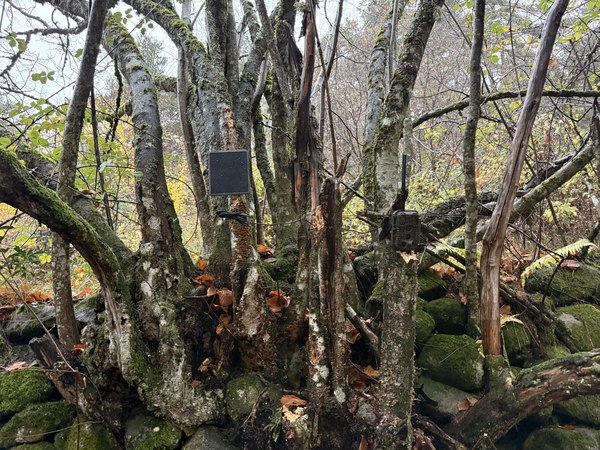
Position the camera outside the mouth, offset to one side, with the opening and likely approach route in view. This helps distinguish an animal walking past from one entering or turning away. FHWA workshop guidance recommends monitoring crossing edges to capture animals' decisions rather than relying only on the middle of a structure.
There is no universal mounting height or distance. Small mammals need coverage close to ground level, while larger animals require a wider frame. Test camera placement against the actual opening, bank slope, target animals, and the camera's usable detection zone.
Aim so an approaching animal moves across part of the sensor's detection zones while remaining in frame long enough to record. A diagonal view can balance these needs. Avoid a view dominated by a sunlit road, moving vegetation, or water reflections, and do not clear habitat simply to obtain a wider shot.
Use both ends when the question is complete passage
One camera can document activity at one entrance. Where access is authorized and safe, use a second camera at the opposite end to strengthen passage interpretation. Synchronize their clocks, use the same time-zone settings, label the ends A and B, and check clock drift during service visits.
Do not impose an arbitrary travel-time cutoff to match clips. An animal may pause, forage, or turn back inside. Treat sequences as probable unless identity and movement are clear; if another route connects the views, note that limitation.
Keep equipment clear of water and maintenance work
Mount on a stable support outside the flow path and anticipated debris zone. A dry installation day does not establish the highest water level. If a safe location cannot be identified, consult the culvert owner or manager rather than mounting equipment low inside the pipe.
Do not enter a culvert to install or retrieve a camera. Keep away from traffic, unstable banks, and rising water. Obtain permission before using road rights-of-way or attaching equipment to structures, and never obstruct drainage, alter grates, or install passage ledges as a monitoring shortcut.
Can Trail Cameras Record Animals Moving Through Culverts at Night?
Yes. A trail camera with infrared illumination can record nighttime activity within its usable range. Infrared night footage is usually monochrome, and a clear image at the entrance does not mean the camera can illuminate the entire tunnel.
Night vision performance depends on placement as well as equipment. Close concrete walls, metal surfaces, vegetation, or water can reflect illumination and obscure an animal. Test after dark from outside the culvert, review the actual files, and adjust the angle if the entrance is bright but the animal's route is not visible.
- Separate detection from illumination: a PIR sensor triggers capture; infrared LEDs provide light for the image. Neither guarantees that every animal is recorded.
- Test a short burst or video: bursts help capture direction, while video may reveal hesitation or retreat. Choose supported settings that preserve useful behavior without exhausting storage.
- Check recovery gaps: long delays between triggers can miss a following animal or an exit. Shorter delays increase storage and power demand.
- Expect detection bias: small animals and animals with little thermal contrast against the background can be missed. A human walk test does not validate detection of mice, frogs, or turtles.
For basic trail camera setup, verify the date, time, recording schedule, supported memory card, and battery condition before deployment. An unintended daytime-only schedule can make a busy nighttime crossing look inactive.
What Animals Commonly Use Wildlife Culverts?
Potential users depend on your region and the structure's size, length, water level, substrate, and surrounding habitat. Do not treat a large wildlife underpass and a narrow drainage pipe as interchangeable.
A 2019 ICOET conference abstract by Caltrans' Jennifer Moonjian reports documented crossings on California's State Route 46 by raccoons, foxes, skunks, opossums, rabbits, coyotes, bobcats, and deer, among other mammals. Those observations came from purpose-built undercrossings and enhanced large box culverts; they are not a species checklist for every private driveway culvert.
- Small and medium mammals: locally occurring raccoons, skunks, opossums, foxes, and rabbits may be reasonable monitoring targets, depending on access and habitat.
- Larger mammals: some larger structures accommodate deer or other large species, but an animal seen nearby may never enter a small pipe.
- Reptiles and amphibians: include them in the monitoring question where relevant, but do not assume a standard motion-triggered mammal setup samples them reliably. Seek species-appropriate advice from a wildlife professional.
Record domestic animals separately from wildlife. If an image does not support a confident identification, use a broader label such as unidentified small mammal rather than guessing.
How Long Should You Monitor a Culvert?
Begin with a short equipment-validation period, then keep the setup consistent. For informal property observation, four to six weeks can be a practical first survey window. This is a planning suggestion, not a scientific minimum or a guarantee that all users will be detected.
Choose the duration around the question you want to answer:
| Your question | A useful monitoring approach | Main limitation |
|---|---|---|
| Is anything using this entrance? | Validate the equipment, then begin a multiweek survey. | One documented entry confirms entry at that opening, not a complete crossing; no detections do not establish that the entrance is unused. |
| Does activity change with conditions? | Repeat comparable survey windows across seasons and water conditions. | Changes in placement or downtime can mimic changes in animal activity. |
| Has a new crossing become effective? | Develop a longer-term study with a wildlife professional. | Usage alone does not prove reduced collisions or population connectivity. |
The FHWA monitoring handbook cautions that even one- or two-year programs can be too brief to capture adaptation and variability at wildlife crossings. That does not mean a landowner needs years to confirm one animal's presence. It means a short survey cannot establish long-term effectiveness.
After the initial check, space service visits according to battery use, card capacity, weather, and safe access. Inspect after significant weather only when conditions are safe. Record every period when the camera was flooded, obstructed, out of power, or otherwise unable to collect usable observations.
How Should You Record and Interpret the Results?
A simple log makes wildlife observation more useful than a folder of favorite clips. For each event, record the camera and culvert ID, date and time, species confidence, direction, behavior, evidence category, and water or weather conditions. Keep the original files so uncertain sequences can be reviewed later.
Group consecutive clips of an animal lingering at an entrance into a clearly defined visit rather than counting each file as another animal. State your grouping rule and keep it consistent; there is no universal time interval that makes visits statistically independent.
Track sampling effort as well. Ten visits during ten usable camera-nights and ten visits during thirty usable camera-nights describe different observation rates. Count a camera-night only when the camera operated through the defined nighttime interval; for paired passage analysis, use periods when both cameras worked. Do not silently combine one-camera and two-camera records.
FHWA's camera trapping limitations explain why repeated photographs are not a population count and why camera placement influences detections. Likewise, frequent passage records do not establish that road collisions have decreased. Keep conclusions tied to what your setup actually measured.
Which Camera Setup Makes Sense for Your Property?
Start by comparing trail cameras for a clear nighttime view, dependable timestamps, suitable recording controls, and an enclosure appropriate to the installation site. Evaluate the exact model's documentation rather than choosing by megapixel count alone. Weather resistance is not permission to submerge a camera.
If safe visits are straightforward, local memory-card recording may be sufficient. When avoiding routine visits is a priority, consider cellular trail cameras, but check compatible coverage at the planned mounting point, plan requirements, and which files the system transmits. A signal outside the culvert does not establish coverage inside it, and remote access does not eliminate maintenance.
GardePro's general and cellular camera collections provide starting points for those different needs. Choose a model only after checking its current specifications against your location and monitoring goal; no single camera setup is right for every culvert.
Frequently Asked Questions
Should I use bait to see whether wildlife will enter?
No bait is needed for this observation task. Food or scent attractants can change movement, undermine your natural-use baseline, and create wildlife conflicts. Observe existing routes without trying to draw animals toward a road.
What if I record no animals?
Check power, storage, timestamps, schedules, detection coverage, and nighttime exposure before interpreting the result. Then consider season, water level, and alternative routes. Report no detections during the stated usable period, not that wildlife never uses the culvert.
Should I move the camera if the culvert floods?
Do not approach rising water to save equipment. After conditions are safe, reassess the location with the owner or manager and document any change. Keep pre-move and post-move observations distinguishable because detection coverage may differ.
Build Evidence Before Drawing Conclusions
Good wildlife culvert monitoring starts with a precise question and a safe, tested view of the entrance. Separate approaches, entries, retreats, and probable passages; record downtime; and revisit the same question across relevant seasons. Choose equipment that supports that method, rather than expecting a camera alone to explain how wildlife uses the road crossing.
